

I was walking along the Sentosa Nature Trail when something unusual caught my eye. The forest floor was covered with what looked like scattered cotton. White fibres drifted across the path, clung to branches, and collected beneath the trees. For a moment, it looked as though someone had emptied dozens of pillows into the forest.
Curiosity led me closer, where I discovered another fascinating phenomenon—a swarm of brilliant scarlet insects scattered across the forest floor among the cotton-like fibres. It felt as though I had stumbled upon a hidden seasonal event, one that quietly unfolds beneath the towering Kapok trees each year.
A forest covered in silk

The mysterious “cotton” comes from the Kapok Tree (Ceiba pentandra), also known as the Java Cotton Tree. As its woody seed pods mature, they split open to reveal hundreds of black seeds wrapped in silky white fibres known as kapok floss. The lightweight fibres catch the wind, carrying the seeds away like tiny parachutes to begin the next generation of trees.
What appears to be a messy forest floor is actually one of nature's most elegant methods of seed dispersal.

Interesting link
https://www.nparks.gov.sg/florafaunaweb/flora/2/7/2797
Singapore's living giants
The Kapok is one of the largest trees found in Singapore. In natural tropical forests, it can grow to an astonishing 50–70 metres tall, developing massive buttress roots and broad, horizontal branches that resemble the tiers of a pagoda.
Remarkably, only nine Kapok trees are listed on Singapore's Heritage Tree Register, making each of these giants an important part of our natural heritage. The very first Heritage Tree registered in Singapore in 2001 was a Kapok standing beside the Braddell Road flyover, while another Heritage Kapok in the Singapore Zoo holds the record for having the largest girth of any single-trunked Heritage Tree in the country.
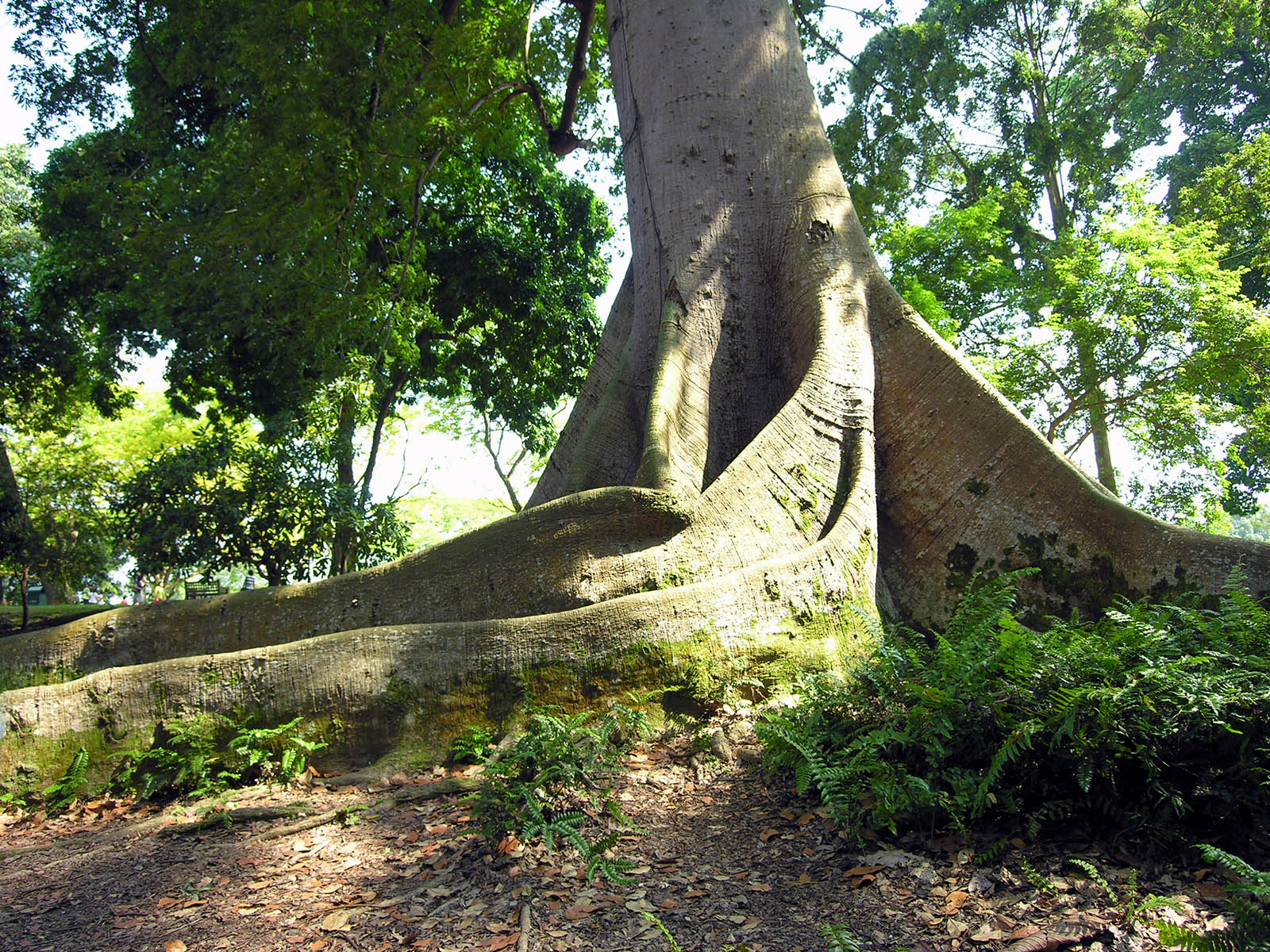
These towering trees are far more than landmarks—they provide shade, shelter wildlife, and quietly continue a life cycle that has repeated for generations.
Interesting link
https://heritagetrees.nparks.gov.sg/explore/heritage-tree-register/
More than just fluffy cotton

For centuries, kapok floss was one of nature's most useful fibres. It is incredibly lightweight, elastic, water-repellent, and naturally buoyant. Before synthetic materials became common, it was widely harvested throughout Southeast Asia for everyday life.
Common traditional uses include:
Pillows and bolsters — soft yet resilient stuffing.
Mattresses and cushions — breathable natural filling.
Life jackets and life buoys — its buoyancy helped keep people afloat.
Sleeping bags and insulated padding — valued for its light weight and loft.
Even the tree offers more than its fibres. The seeds produce an oil once used in soap and lubricants, while the empty fruit pods have traditionally been used as pulp material and compost.

The scarlet visitors

Among the white silk were dozens of brilliant scarlet insects. Their vivid colour stood out beautifully against the pale fibres, creating one of the most striking natural scenes I've encountered.
They are Cotton Stainer Bugs (Dysdercus spp.), not stink bugs as many people first assume.
Unlike shield-shaped stink bugs, cotton stainers have a slender body, long antennae, and distinctive black wing tips. Rather than feeding on the silky floss, they pierce the nutrient-rich seeds hidden within it. Wherever kapok pods burst open, these brilliant insects are often close behind, taking advantage of an abundant seasonal food source.
The brilliant red insect is a true bug belonging to the family Pyrrhocoridae. Although its striking colours make it look like a warning insect, it is harmless to people and spends almost its entire life around seed-bearing trees such as kapok, hibiscus and cotton.
Where do they lay their eggs?
Surprisingly, cotton stainers do not lay their eggs on the tree.

After mating, the female flies down to the ground and digs a shallow chamber in soil, leaf litter, or decaying plant debris beneath the host tree. She lays batches of creamy yellow eggs, usually hidden a few centimetres below the surface where humidity protects them from drying out.

The eggs hatch in about 5–8 days, and the tiny first-stage nymphs remain underground before emerging to climb the host tree in search of fallen or opened seed pods. They gradually develop through five nymphal stages before becoming the familiar scarlet adults, completing their life cycle in roughly one month under warm tropical conditions.

Do they harm the Kapok Tree?
For a mature heritage kapok, very little.

Cotton stainers have a long, needle-like mouthpart called a rostrum (or proboscis), folded beneath their body when not in use.
When feeding, they:
Walk through the kapok floss until they locate a black seed.
Extend the rostrum and pierce the seed coat.
Inject digestive saliva that begins breaking down the nutritious tissues inside.
Suck the liquefied contents back through the rostrum like drinking through a straw.
The white silky floss is not their food—it simply surrounds and protects the seeds.

While individual seeds may be eaten, a single kapok tree produces thousands of seeds each fruiting season. The cotton stainers consume only a fraction of this enormous seed crop, making them part of the tree's natural ecological community rather than a serious threat. Their presence is better viewed as nature's version of seed predators—similar to squirrels feeding on acorns—helping shape which seeds ultimately survive.
5 Fascinating Facts about the Cotton Stainer Bug trees.
It doesn't eat the silk. The bug uses a needle-like rostrum to pierce the black kapok seeds and drink the nutrient-rich contents inside.
Its nursery is underground. Females lay their eggs in moist soil and leaf litter beneath the kapok tree—not on the tree itself.
It grows through five nymph stages. Unlike butterflies, cotton stainers undergo incomplete metamorphosis, molting five times before becoming a fully winged adult.
It's bright red for a reason. The vivid scarlet colour is believed to warn predators that it is unpleasant to eat, a common survival strategy among true bugs.
A pest in farms, but not in forests. While cotton stainers can damage commercial cotton crops, they are a natural part of Singapore's woodland ecosystem and rarely harm mature kapok trees.
5 Fascinating Facts about the Kapok Trees.
One of Singapore's tallest trees. Kapok trees can reach 50–70 metres in tropical forests, towering above the surrounding canopy.
Only nine are Heritage Trees. Singapore has just nine registered Heritage Kapok Trees, recognising their exceptional size, age, and ecological value.
The largest trunk measures 11.9 metres. The Heritage Kapok at Singapore Zoo holds the record as Singapore's largest single-trunked Heritage Tree by girth.
Its “cotton” once saved lives. Before synthetic materials, kapok floss was widely used to fill pillows, mattresses, and even life jackets because it is naturally buoyant and water-resistant.
A giant tree born from tiny parachutes. Each fruit contains hundreds of seeds wrapped in silky fibres that allow the wind to carry them far from the parent tree.